
Landing Page Process
Overview of Process
This document outlines all the parts involved in creating a landing page. There are several phases that need to occur in order for a landing page to be designed, created, launched and maintained.
The typical length of time for a landing page to be created, from discovery to launch, is approximately 8 weeks. This is contingent on stakeholders and other participants keeping to the timeframe and keeping the project within scope. Any changes in scope,scope or delays in deliverables by their due datesdates, may delay the launching of the landing page.
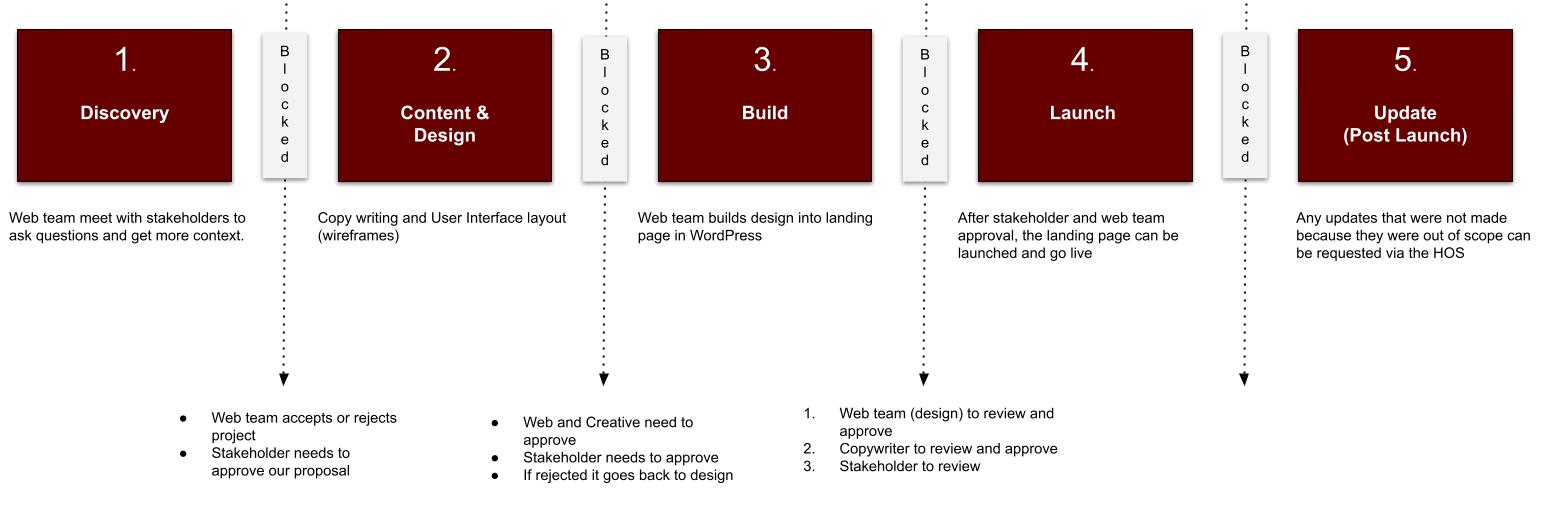
For admins - access the original Google Drawing of the landing page process here.
What is a landing page?
A landing page is simply a single web page that’s built with one goal in mind—getting your visitor to take a specific action (e.g. fill in form, donate, sign up to email, etc). Think of it as a targeted “destination” on your website, where someone arrives after clicking an ad, an email link, or a social‐media post.
What is a discovery meeting?
A discovery meeting is the first structured conversation between you, the team and stakeholder. Its sole purpose is to uncover everything you need to know in order to design the right solution—whether that’s a new website, a marketing campaign, a software project, etc..
Where are the discovery questions?
This is a list of generic discovery questions that will be asked of the Stakeholders. Not every question may be applicable depending on the circumstance. This is just a guide use at your own discretion.
Phases
1: Discovery
- Assemble the team - Once the HOS ticket has been approved by the steering committee, project managers need to identify the people to be on the project. I.e. Web team members, Story team members, Stakeholders, etc.
- Discovery meeting (web team will lead this)- Project managers schedule a discovery meeting with all team members and stakeholders to identify:
- Identify scope
- To gain more context
- Identify hinderances
- Understand the strategy
- Ideate
- Ask clarifying questions, etc.
-
Assets and Expectations - We need t identify what assets are assets required, these need to be fully available before phase 2 starts.
- Who is providing the assets?
-
Images - Where can we get them?
-
Videos, Where to we get the videos? (Note: we don’t upload mp4 files to the site, video need to be YouTube needs embed only)
- Who is providing the copy? Is the stakeholder or the GBMS Story team creating the copy for the landing page?
- Accept/Reject - Based on what is uncovered in the discovery the team will decide if they can/should continue
- Proceed or Postpone - Our the web teams needs (required assets) have to be fulfilled before we start the project. Project will be postponed or delayed in starting if we don't have all the assets required. Copy is an exception if GBMS is creating the copy
If there is no strategy, or the strategy does not align with Jesus Film's objectives, the project will be rejected. Due to limited resources we can only commit to projects that are clearly aligned to the organization objectives and goals.
2: Content & Design
- Wireframes - After the Discovery meeting, the copy writers (Story team) will collaborate with web design (Web team) to develop content, mock-up layouts and eventually wireframe.
- Further collaboration - Copy writers and web designers may need to collaborate with SEO (Web team) if this landing pages needs to rank in search engines.
- Deliverables - The designers (Web team) will present wireframe (this not a finished design) to Stakeholders for approval and feedback.
- Feedback and update - if there is feedback and updates required, these will need to be re-delivered and approved. There is only one round of revisions approved to keep the project in scope. Other changes can be done after the page is live.
- Finalization of wireframes - Once approved, the team can move onto phase 3.
What is a wireframe?
A wireframe is a simple, low‑fidelity sketch of a web page or app screen that shows the basic layout and structure—where elements like the header, navigation, images, text blocks, and buttons will go—without any colors, fonts, or detailed graphics. Think of it as the blueprint or floor plan.
3: Build
- Provide assets - All images, copy, videos and other assets need to be given to the web developer (Web team) in the correct format, size, compression etc.
- Functionality - UX (Web team) to collaborate with web developer to communicate desired functionality, aesthetics and expectations of finalized landing page
- Development - Web developer will proceed on building out the landing page on a staging site
- Approval - Both web team and creative (Story team) need to approve final build of landing page (stakeholders are not included in approval process as this point)
- Review - Stakeholder are able to review the landing page. No further changes will be accepted as this point. Updates can be made post launch.
All landing pages need to built on the staging site first, not the live/production version of the website. The staging site can be found here: develop.jesusfilm.org
4: Launch
- Web team to launch page into production (from staging site)
- Link to landing page URL will be shared to project managers who will share it to respective team members
5: Updates (Post Launch)
- If there are required updates that are simple and easy to fix, such as changing and image, or changing some text, then it will be done post launch
- If there is a significant updated or change required a new HOS ticket will need to be processed.